Responsive image
Under the supervision of UGA, CNRS, Grenoble INP - UGA and INRIA, GRICAD has the mission to support Grenoble research communities in their scientific computing needs as well as data and software management for research. In this perspective, the unit provides expertise to scientific projects and offers a range of freely accessible digital services, along with research accompaniment.

News

SO Cast #02 - OSPO: Understanding and Supporting Open Source at the Heart of Research

Nov 10, 2026

The second episode of SO Cast is now online!

What is an Open Source Program Office? How does it help researchers and laboratories? And why is open-source software essential for the reproducibility and credibility of research?

Read more ...
The CNRS is encouraging public debate on digital moderation

Oct 21, 2026

The CNRS is encouraging public debate on digital moderation

As part of the Altimpact project, led by the CNRS, Ademe and Inria, the CNRS has been trialling local deliberative assemblies dedicated to digital moderation in several French regions (Grenoble, Lyon, Angers, Veynes and Mouans-Sartoux) for the past two years. Inspired by the citizens’ climate assemblies, these initiatives bring together citizens, scientists and local authorities to collectively discuss the environmental, social and societal impacts of digital technology.

Read more ...
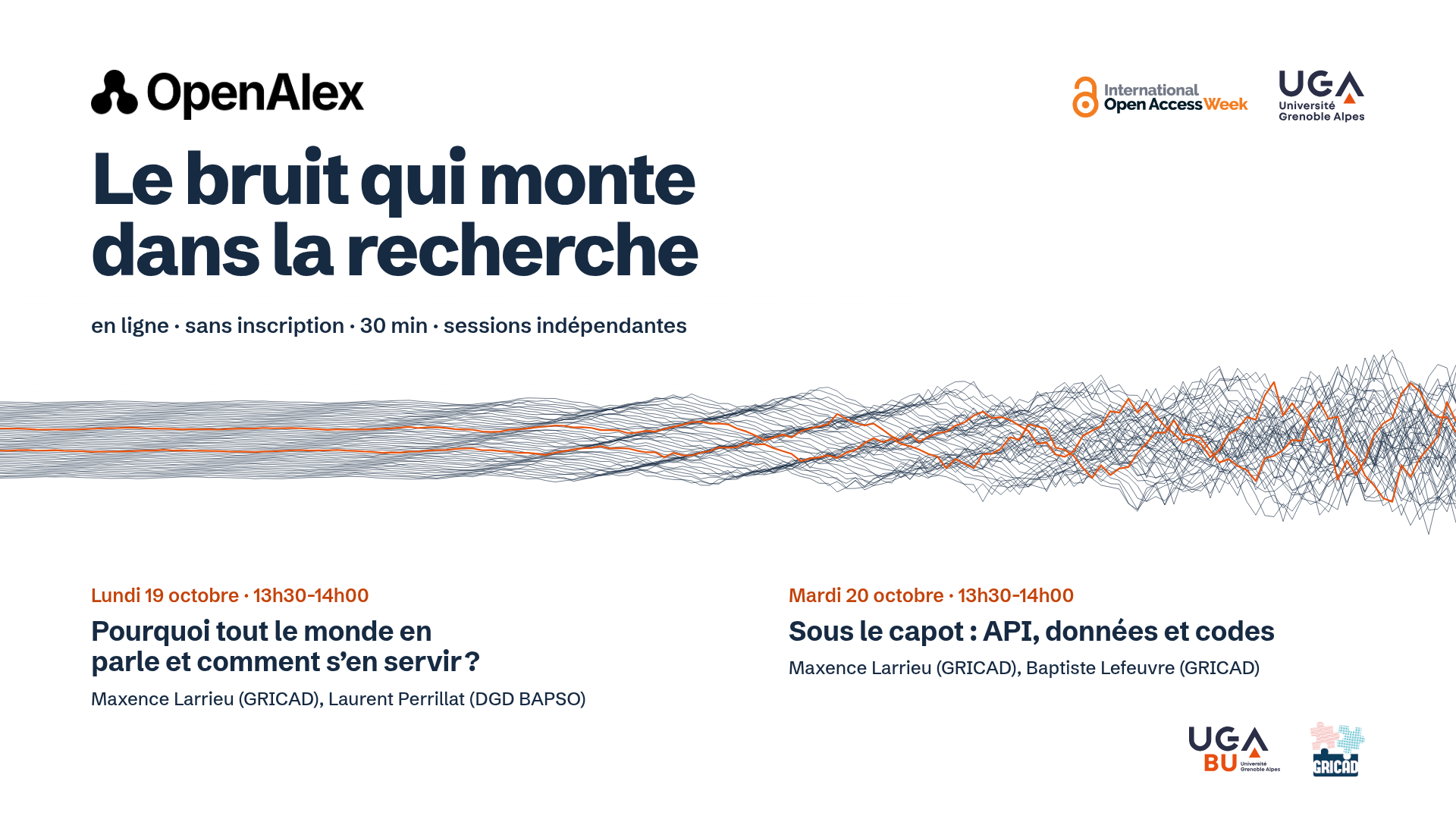
OpenAlex, the growing buzz in research

Oct 9, 2026

Online

Monday 19 october, 1:30–2:00 pm & Tuesday 20 october, 1:30–2:00 pm

Haven’t heard of it yet? OpenAlex is a bibliographic and bibliometric tool, like WoS (Clarivate), Scopus (Elsevier) or Google Scholar. It is shaking up this landscape: it is free to use with no subscription, its data can be freely reused, and it is not produced by a commercial company but is a common good.

Here are two webinars to discover the tool, as part of Open Access Week :

Read more ...
New open science strategy 2026-2033

Sep 28, 2026

The French Ministry of Higher Education, Research and Space has just published the 2026-2033 open science strategy, which aims to consolidate the achievements of the two previous national open science plans (2018 and 2021). Roughly a hundred pages long and organized in four parts (ambition, challenges, objectives and the 2026-2029 action plan), it places open science within a broader landscape – “openness is not practiced for the sake of openness” – and clarifies its contribution to the key challenges of research: visibility, reproducibility, integrity, sovereignty and innovation.

Read more ...