GRICAD is ten years old! A decade of supporting digital technology for research
Sep 1, 2026
In 2026, GRICAD will celebrate its tenth anniversary. Established on 1 January 2016, our unit was created out of a desire to bring together the digital expertise and infrastructure of the Grenoble site in order to support scientific communities with their needs in high-performance computing, data management and research software. Building on the legacy of the CIMENT project (High-Performance Computing, Modelling, Numerical and Technological Experimentation), our unit has, over the course of a decade, become a key player in digital research in Grenoble.
2016: Establishment of GRICAD, building on a legacy developed over nearly 20 years
From its inception – which marked a key milestone in the development of digital research services in Grenoble – GRICAD has been committed to providing shared infrastructure that meets rapidly evolving digital needs.
Under the supervision of the National Institute for Mathematical Sciences and their Interactions (Insmi), the University of Grenoble Alpes, the CNRS, Grenoble INP and Inria, our support and research unit (UAR) brings together expertise, infrastructure and support within a single organisation.
GRICAD builds on the experience of the CIMENT project, launched in 1998 to pool scientific computing resources across the Grenoble campus. This pioneering initiative led to the development of computing platforms, training programmes, networks of experts and a culture of sharing, which still form the very essence of GRICAD today.
Between 2018 and 2026, to meet the growing needs of the scientific communities, GRICAD is deploying and consolidating several major infrastructure projects. A comprehensive ecosystem of services is gradually being built, covering high-performance computing, artificial intelligence, cloud computing, storage, software development, etc.:
· DAHU: high-performance computing and data analysis, 2018;
· BIGFOOT: GPU computing and artificial intelligence, 2018;
· NOVA: cloud computing platform, 2018;
· BETTIK: high-performance storage, 2018;
· MANTIS2: high-capacity cloud storage, 2020;
· ELI: data mining, 2021;
· GITLAB: software development;
· KRAKEN: CPU and GPU computing, data analysis: 2025;
· ARES: elastic allocation, LLMs and on-demand services: 2026.
In January 2026, the inauguration of the CINAURA-KRAKEN data centre marked a new milestone in the development of our infrastructure. It complements and strengthens our offering, supporting computationally intensive research projects ranging from fundamental physics to digital sciences and artificial intelligence.
Furthermore, since 2021, GRICAD has been heavily involved in the MESONET project, which aims to establish a distributed national infrastructure, incorporating at least one mesocentre per region, designated as regional reference centres and hubs. As part of this national collaboration, our unit has played an active role by acquiring and operating an OpenStack platform for cloud computing, supported by the UGA.
Behind these infrastructures are, above all, the men and women who, for the past ten years, have been designing, operating, maintaining and developing digital services on a daily basis, working closely with the scientific communities.
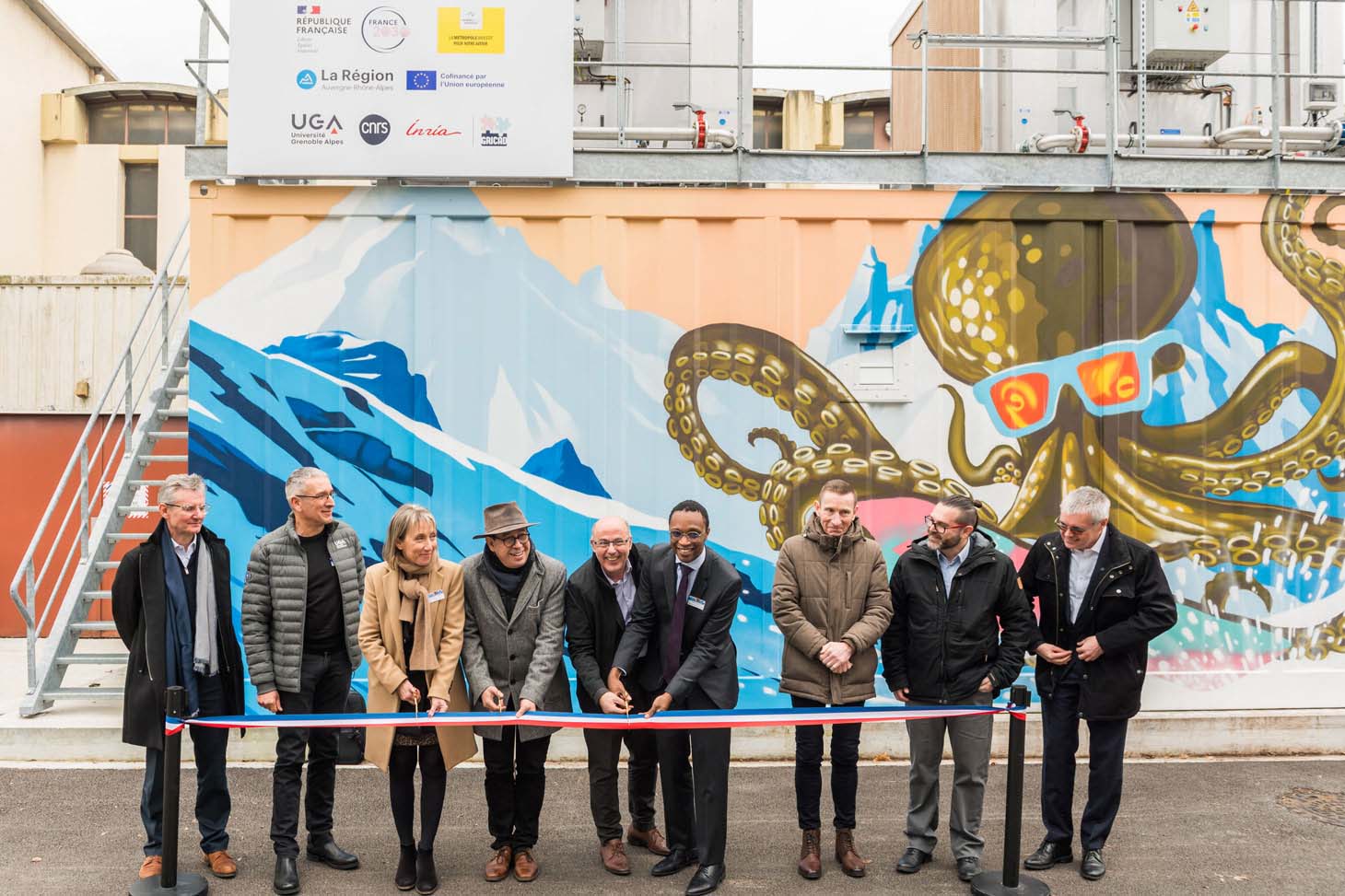
Inauguration of the CINAURA-Kraken computing cluster by the research partners and institutional funders of this new supercomputer
Supporting and bringing together research communities
Over the years, training courses, seminars, Cafés Guix, scientific events, support initiatives, audiovisual productions and podcasts have been developed and have become a regular feature of community life. These initiatives help to disseminate best practice in computing, data, reproducibility and research software management.
This dynamic is underpinned by a governance structure that closely involves users. Established in 2018, the Scientific and Technical Users’ Committee (COSTU) is tasked with ensuring that infrastructure and services are steered by research needs. Reflecting the needs of Grenoble’s scientific and technical community, its practices and its professional fields, it helps to steer GRICAD’s development in a way that closely aligns with the expectations of those on the ground.
The rapid emergence of artificial intelligence (AI) in recent years has also led the unit to step up its involvement in this field. It has therefore become involved in several national initiatives, notably the National Artificial Intelligence Research Programme (PNRIA), led by the CNRS, INRIA and the CEA to support the scientific community in adopting AI methods, as well as the MIAI Cluster, which stems from the France 2030 plan and aims to strengthen research, training and innovation in AI. This initiative has been accompanied by the launch of new services, such as Alan, GRICAD’s LLM service, which provides access to language models (LLMs) running on the CIMENT-KRAKEN infrastructure, offering a sovereign environment for generative AI applications, and the ACDC (Academic Committee for Data Challenges), which supports teams in designing and deploying data challenges on the Codabench platform.
The rise of open science and research support
Beyond infrastructure, GRICAD has developed support services centred on research data, scientific software and open science practices. The unit is helping to shape a genuine Grenoble-based ecosystem centred on scientific data and code, notably since 2019 through its joint management, alongside BAPSO (Library and Open Science Support), of the Grenoble Alpes Data and Code Unit (CDGA) and Science Ouverte Grenoble Alpes. Furthermore, through its technical, legal, promotion and software cataloguing activities, the CDGA embodies the Open Source Programme Office (OSPO) at UGA.
Our unit is also involved in initiatives to promote reproducible research, through seminars, online workshops and collaborations centred on tools such as Guix for managing reproducible software environments.
Furthermore, since 2024, GRICAD has been leading the Data strand of the GATES, dedicated to the Humanities and Social Sciences (HSS) and launched as part of the France 2030 plan through the ‘Excellence in all its forms’ initiative, one of the key measures at the heart of the 4th Future Investment Programme.
Finally, since 2020, GRICAD has been actively contributing to several national and European projects related to open science and research data management, notably through its participation in the Recherche Data Gouv (RDG) and the European Open Science Cloud (EOSC).
Digital frugality and responsible digital practices
Over the past ten years, GRICAD has been heavily involved in issues relating to the environmental impact of digital technology. Our unit develops awareness-raising initiatives and resources centred on digital frugality. It supports laboratories in assessing their environmental footprint and implementing appropriate policies.
In 2023, the UGA received the 2023 Code of Conduct for Data Centres Award from the European Commission for its DC-IMAG data centre, managed by GRICAD. This award recognises the centre’s energy efficiency and the best practices it has implemented.
2026: A landmark year!
2026 is a year marked by two major events.
Firstly, the inauguration of the CINAURA-Kraken supercomputer is one of the highlights of this decade. With significantly enhanced computing power, this infrastructure is designed to meet researchers’ needs for years to come, whilst underlining the importance of digital sovereignty and the pooling of resources.
Secondly, following a lengthy preparation process, GRICAD has obtained ISO 27001 certification, attesting to a high standard of information security. At the same time, our organisation has officially become a Health Data Host (HDS), paving the way for new projects addressing data security challenges.
What about tomorrow?
Ten years on from its creation, GRICAD remains committed to its mission: to harness digital technology for research, by combining cutting-edge infrastructure, human expertise, open science and environmental responsibility. The challenges are evolving – from big data to artificial intelligence – but the aim remains the same: to enable scientific communities to innovate, explore and generate new knowledge.